
Words-Images Maria Anna Potocka
Words – images
In concrete poetry, both the significance of the word and its form count, thus, it is also called visual poetry.
Maria Anna Potocka (born in 1950) a curator and art critic. In 1972-2010, she was running contemporary galleries (Galeria Pl, Galeria Pawilon, Galeria Foto Vido, Galeria Potocka). Since 1984, she has been creating contemporary art world collections. A member of Internationale Künstler Gremium, AICA (1996-2003 president of the Polish Section), ICOM. A curator of many exhibitions in Poland and abroad. Author of books: Painting (1995), Sculpture (2002), Esthetics against art (2006 Ph.D. thesis), It’s Only Art (2008), Photography (2010), Political accident (2010) and many other theoretical and philosophical texts. In 2002-2010, director of Galeria Bunkier Sztuki. Since 2010, director of Museum of Contemporary Art in Krakow (MOCAK).
The first condition of creative concrete poetry is the poetic sense of words, in other words, the talent of a poet. The next condition is the intuition for meanings comprised in the form of words. This, for a change, is the talent which belongs to an artist. Concrete poetry requires being attentive to the literary as well as to artistic and sensitive meanings at the level of nuance because everything takes place with the minimum amount of words and images. Due to this complicated combination of talents, there are only a few authors of concrete poetry. Admittedly, in the 70 s there was an “inundation” of concrete poets but it rather resembled a fashion than an artistic determination.
On the Polish stage, the most important artist of this movement was Stanisław Dróżdż. He was the only one who went down in Art History. His poetic-visual activity started in the mid- 60s and incessantly lasted for 40 years. Its overview reveals an astonishing phenomenon; Dróżdż’s works do not depend on times and they are not subject to its negative influence. Without the knowledge about the date of their creation, it’s hard to imagine the chronology because all of them seem to be entirely contemporary. It is not the end of their phenomenon. The next astonishing aspect is the lack of relations between them and of interior inspirations. It can explain their timelessness because thanks to that there is no impression of development. These works are inviolably current and endlessly self-reliant. The entirety of this artistic event is limited by the visual poem and it doesn’t depend on the context of other works or of the exterior explanations.
Concrete poetry uses simple meanings and geometrical forms of words. It uses detached words or signs extoling their meanings with the usage of a precise graphical composition. With such minimal means, every detail is endlessly important. Concrete poetry doesn’t accept redundancy. Everything which appears in the poetic composition is necessary and unique. Thanks to its simplicity and uncompromisingness, the concrete poem livens up and activates the texts which collapsed in the callousness of obviousness. Its extraction requires the artist's sensitivity to the smallest symbolic-visual dependences.
In works of Stanisław Dróżdż, the sophistication of this sense achieves the level of genius. Even though this method, talent and sensitivity of sign are common for all his works, each of them plays with words in a different way and emphasizes a different problem. Still, it’s always a fragment of an existential fundament.
Forgetting is a poem within which the title word is written many times, one after another. On top, the entire word, then beneath, the abbreviated word by one letter, then again abbreviated by one more letter, and slowly the words losing their identity in the process of forgetting. The letters are heavy and strictly adjoin each other. One can feel the effort and in the meantime the irreversibility of the detachment of letters from words. One can grasp the moment when the detachment of the following letters destroys the meaning. The remains of the word are only forgetting about Forgetting.
The work which propels even more the interpretation is the composition of six boxes where there were shown “white” and “black” words with the white and black changing backgrounds. The word on its own background is certainly entirely helpless and invisible. On a foreign background, it is perfectly visible but it takes place at the cost of dependences on the opponent thanks to whom a contrastive exposition is possible. It suggests the fatality of the opponent presence or the incapacity of the existence without contrast which is assured by the opponent. The next enrichment may be the entry to one’s own history, and decision what constitutes the contrast of our exposition, who is the opponent on the background of which we are seen. We can move even forward and analyze the advantage of the hostile background and the prospective possibility of its change. It is important to remember it is a game and we invent the rules. The artist does not take responsibility for that and does not provide the recipient with the information which direction seems to him the most appropriate.
Nevertheless, many works contain in their titles interpretational suggestions. The threefold composition within which the upper board is covered with question marks, the middle one by question marks mingled with exclamations marks and the bottom one only with exclamation marks, was titled Incertitude – doubt - certitude. Giving such a title, the artist reveals the intention of the work “portraying” the monotony and in the meantime the simplicity of these three abstractions, which, to an enormous extent decide about our behaviour.
Interpretation is also provided by Solitude, in which on the black background, a white one was placed. Solitude may have many different tastes but when it is expressed in the form of isolation and the background gives an impenetrable darkness, then what is suggested is a total solitude damned to “autotherapy.“ The fulfillment which is suggested by the poet seems to have an unequivocally determined direction. Solitude is not a territory of the acquired liberty but the territory of sad isolation.
Apart from works of which size and way of exhibiting resemble traditional images, Stanisław Dróżdż creates extended compositions which play with the space or which build space for themselves. In the terms of the display, his works are incredibly spectacular.
A circle is a composition of 16 squares. Each of them comprises a word “circle” inscribed in a circular way. Squares are arranged in equal distances on the floor. We are walking around them. From the above, we see those from the side, those underneath, at an angle. We are spinning around, anxious by these distinct images of the same word. At the first moment, we try to blame our position for it, the imperfection of the angle of looking. However, it turns out that these differences are comprised in the record of the word. On every square, the word “circle” has a slightly different course as if it was caught at a different moment of the circular movement. There are diverse variants but each of them is a “circle”. It appears that setting it in motion is not capable of take the “circle” out of its meaning. In this case, semantic identity seems to be very resistant. The identity of the word overcomes any measures of deformation. Circle involves into the reception enforcing the spinning around itself and enforcing the entrance in the field of its own events.
The installation Between is even more engaging for the recipient. This visual poem has a form of a small room of which walls are covered by accidentally arranged letters constituting the word “between”. Since six letters allow a big amount of combinations, it is impossible to find “between” written correctly. However, regardless of the title, there is absolutely no doubt about the word in question. This work insistently circles around the word which isn’t possible to be constructed. But despite a lack of success, the word is incessantly present. Observing the effort of the instance, we force our perception to consider the word which is the intention of work. We see it even though it doesn’t appear.
Stanisław Dróżdż’s work perfectly responds to the term of timelessness. Artistic events of the last 40 years in the lowest extent didn’t breach its topicality. In those works, there’s no trace of the past. This independence of time is the merit of the lack of compositional ornaments and the longevity of meanings which are transmitted by words.
Maria Anna Potocka (born in 1950) a curator and art critic. In 1972-2010, she was running contemporary galleries (Galeria Pl, Galeria Pawilon, Galeria Foto Vido, Galeria Potocka). Since 1984, she has been creating contemporary art world collections. A member of Internationale Künstler Gremium, AICA (1996-2003 president of the Polish Section), ICOM. A curator of many exhibitions in Poland and abroad. Author of books: Painting (1995), Sculpture (2002), Esthetics against art (2006 Ph.D. thesis), It’s Only Art (2008), Photography (2010), Political accident (2010) and many other theoretical and philosophical texts. In 2002-2010, director of Galeria Bunkier Sztuki. Since 2010, director of Museum of Contemporary Art in Krakow (MOCAK).
Podpisy pod ilustracjami:
Stanisław Dróżdż, Forgetting, 1967, printout, phot. R. Sosin
Stanisław Dróźdż, Between, 1977/2004, installation, Collection of MOCAK, phot. R. Sosin
Stanisław Dróżdż, Fifty fifty, 1998, collage, Collection of MOCAK, phot. R. Sosin
-
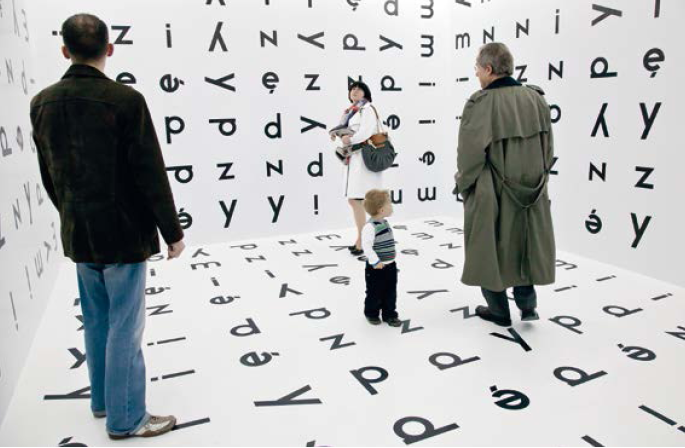 Stanisław Dróźdż, Between, 1977/2004, installation, Collection of MOCAK, phot. R. Sosin
-
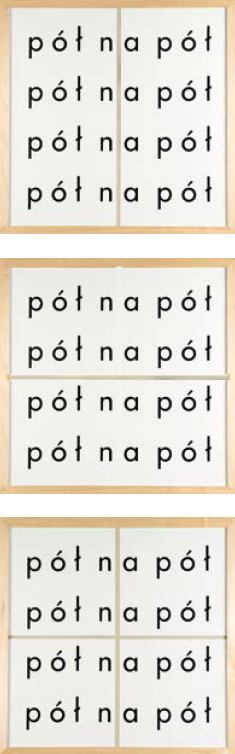 Stanisław Dróżdż, Fifty fifty, 1998, collage, Collection of MOCAK, phot. R. Sosin
-
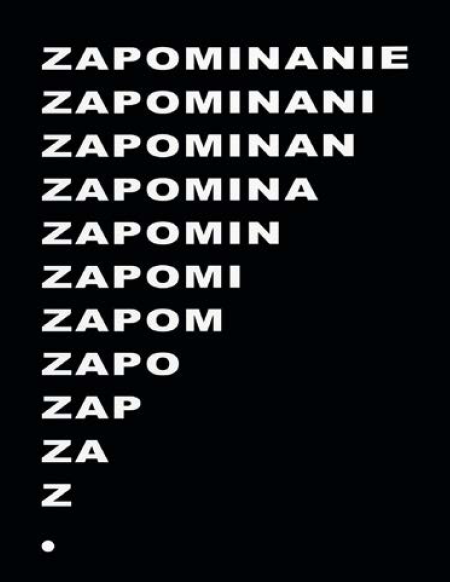 Stanisław Dróżdż, Forgetting, 1967, printout, phot. R. Sosin

