
Unobvious object Maria Wegenke
The joint of visual arts and literature is a fascinating place which gives artists, who master the word and image, a possibility to find a common language in the land of imagination.
Common reading started to have new forms. Traditional paper books are pushed to the margin by the digital form of text displayed on screens and on audiobooks.
However, for people sensitive to beauty, nothing will replace the contact with the paper form of printed literature. The scent of printing paint, rustling under the touch of fingers, gives the reader an additional sensual pleasure of intimacy with a real object and the virtual equivalent.
An art object can also connect with the recipient’s imagination which in its purpose is supposed to have a direct contact with paper.
Truman Capote, after a visit at Sidone Gabrielle Collete, in her Paris apartment, was fascinated by paper buttons. Then he started to collect them by himself. Grande mademoiselle of French literature, according to the way he was calling her, had a serious collection, about which we can read in Dogs bark: there were maybe a hundred of them and they took place on two tables situated at both sides of the bed; crystal balls which imprisoned inside green lizards, salamanders, millefiori bouquets, dragonflies, a basket of pears, butterflies sitting on fern leaves, winding white and blue white meanders, sparkling like fireworks, cobras prepared to jump, cute little sets of pansies, amazing poinsettias.” 1
It seems that Bartek Buczek shared a similar fascination. Artist invites us to see his projects of paper buttons. The abstractive forms, characteristic of Buczek’s works, presented in the educational inset gain new, more practical application. The artist encourages us to look at it with a fresh look on the concept of the paper button and finding joy in the quest for beautiful forms for the object of a trivial function. Let’s accept the invitation and choose from our surrounding an object, formed by nature or a human hand which will receive a new function. Let’s create a paper button.
(1) T. Capote, Dogs bark/ Psy szczekają, ibid., White Rose, translated by B. ZIeliński, Muza, Warszawa 2000, p. 23-24.
Maria Wegenke (born in 1983) – A graduate of graphic arts and pedagogical studies at the Academy of Fine Arts in Krakow. At Mocak, she works at the Education Section where she carries out workshops and museum lessons for different age groups. She also cooperates with the National Museum in Krakow.
Bartek Buczek (born in 1987) – a visual artist, a secondhand bookseller, a graduate of painting at the Fine Arts Academy in the studio of Andrzej Tobis. A former member of the group Ośmiornica.
-
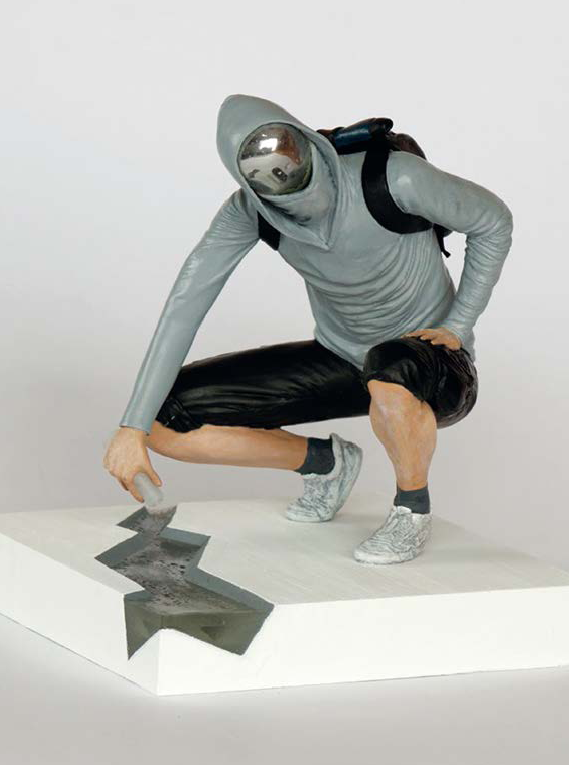 Bartek Buczek, Poison Storm, object, 2010

