
Times of text-images Roma Sendyka
In 1924, in between ME from One Side and ME from the Other Side of My Pug Iron Stove and Lucifer Unemployed, Aleksander Wat, together with Henryk Berlewi, founded an advertising agency Reklama-Mechano. Nowadays, from the collections of the institution's realizations only one work is left: an advertising brochure of Plutos chocolate factory. It is a sixteen page booklet, dimensions: 15 × 15 cm. Its ten pages were published by the Digital National Museum in Warsaw (1), three other pages can be found in Piotr Rypson’s (2) work. This brochure of a genuine Warsaw pastry company, is usually attributed to Berlewi, and that is why I would rather pay closer attention to the contribution of Wat, which is virtually forgotten. Obviously, the knowledge that the author of Dark Light literally built a multifaceted metaphor of the "wonderful untold Scheherazades of the gourmandise” will not affect the interpretation of Mediterranean Poems. However, the fact that in an advertising project, being a symptomatically modern practice of the "age of Chaplin, Einstein and jazz-band ", Berlewi worked exclusively in the company of poets (except for Wat there was also Stanisław Brucz), which helps to pose the question: how important for the authors was an escape from this neutral font "which we do not see" to an intense, almost obsessive imaging of a text? I am convinced that in the advertising texts of Wat, the visuality is a semiotic carrier and it brings us further than to the statement of the "dynamics" of red, the diagonal lines and a disappearing line of handwriting. The imagery of words must be possible to understand and name, because it works for us and affects the meanings that we create. What we know about printing and typography thanks to Strzemiński, still seems to be no possible substitute for an analysis of some future "logic of text-images", automatically built over a declaratory gap between a word and an image.
Between a word and an image
Systematic studies on text-images objects began half a century ago. The first important book was the work of Michel Butor – a writer, philosopher and critic associated primarily with the literature of the new novel (nouveau roman). It is quite surprising when we consider the fact that this experimental writer’s interests lied in the sphere of more radical verbal productions. In Les Mots dans la peinture (1969) (3), Butor collected the examples of various methods of inserting text into the paintings: ranging from these epigrammatic (in the sense that a texts, in a more credible way, appeared on the objects by means of filling out the registers, letters or boards), to the fluid, unrestricted appearances of a text in “non-empirical” configurations. The oldest examples from Butor’s book come from the sacral art where a text created halos of the saints, ribbons and floating sentences from a character’s mouth, panegyrics in the background of the portrayed characters, captions identifying the main characters of a scene, sayings and proverbs in different configurations, or signatures and informative descriptions placed under a painting.
First attempts to deal with this theoretical alliance of image and text appeared simultaneously to the work of Butor and were clearly inspired by structuralism. Consequently, they favored such a way of thinking which differentiated the orders of image and text. In 1971, Mieczysław Wallis in his work Captions in paintings/ Napisy w obrazach (4) cataloged, as Butor did, the examples of mixed image-text (the inscriptions, original creeds, invocations, etc.), obviously searching for some clear distinctions. He proposed to call a text inserted into a painting "a semantic enclave of a work of art in the form of captions" and defined this separated piece of another reality as a "part of a work of art consisting of signs of a different kind or from a system different the whole work." (5)
Meyer Schapiro, in his book Words, Script and Pictures (1996) identified a radical point of separation of words and visual representation in Renaissance, when it came to "a concept of an image as a unified whole, presented to the eyes as a coherent visual object." (6) Images – as the Earl of Shaftesbury once stated – should be “eusynoptic”, easy to grasp at first glance. This formula for a masterpiece excluded writing from a painting, because it was sequential and linear. Writing was of a different order than bodies, faces, gestures and objects. Meanwhile, the examples which illustrated the analysis of Butor, could not be easily inserted into into such distinctions. There were many "non-eusynoptic" masterpieces of Renaissance paintings, and in later periods. Such texts can be found in paintings by Giorgione, vanitas bands and apothegms more than tolerated in Baroque paintings, small written cards that can be tracked down in works of Ingres, etc., but also in the poems appearing on the canvas of Rossetti, and texts of letters and books’ pages situated in the visual foreground of Arles still lives of Van Gogh.
While in these examples the enclave method introduced by Wallis secures its operability, insofar as the first decades of the twentieth century nobody really knows how to relate to text-images. There are many of them and the writings placed within the frame of the canvas do not respect any rules of separation: the "words at large" of Marinetti seem spinning and falling down to the world of the futurists, the scraps of newspapers are pasted on the paintings of Picasso and Braque, Picabia builds machines out of words and items, Kandinsky fills the canvases with letters of a crazy alphabet (Succession, 1935), and Paul Klee’s poem Einst dem Grau der Nacht enttaucht” from1918 is both a text and a painting: each letter is a visual masterpiece, nothing more but an elaborative depiction of words was put on the painting. In Miro’s work (Escargot, femme, fleur, étoile, 1934) a black ribbon of a brush creates simultaneously words and images, ignoring the structural differences of their "state of being signs". At around the same time Virginia Woolf dreamed to "Let us hold painting by a hand for a moment longer, for though they must part in the end, painting and writing have much to tell each other; they have much in common”. (7)
In the 60s, when critics made attempts to formally categorize and organize mixed objects, the art seemed to be for from removing the provocative distinctions. The title of one of the latest books on the modern art made of words (Liz Kotz, Words to Be Looked At, 2010) refers to Robert Smithson's famous commentary. He described the exhibition at the Dwan Gallery in New York in 1974 as consisting of Language To Be Looked at / or Things to be Read. Kotz browses linguistically-oriented art of the 60s, selecting as symptomatic the minimal texts of George Brecht, poetical collages of John Ashbery and Jackson Mac Low, experiments of Carl Andre and Vito Acconci, and numerous projects from the area of conceptual art: Victor Burgin, Dan Graham, Douglas Huebler, On Kawara, Joseph Kosuth and Lawrence Weiner (8). To her own incomplete list, Liz Kotz proposes to add – in the future analysis – the works of Tony Conrad, Walter De Maria, Henry Flint, Dick Higgins, Alison Knowles, Robert Morris, Yoko Ono, Mieko Shiomi, as returning to minimal and conceptual art, as well as to the actions of Fluxus.
The second half of the twentieth century was not less abundant in this respect. Simon Morley, in his work Writing on the Wall describes in a systematic way the visual works of art that use text. He adds to the list the following artists: Mel Bochner with his manifesto Language is Not Transparent, Andy Warhol, Jasper Johns, Roy Lichtenstein and Robert Indiana with their pop-words. In the orbit of text-images, we can also place the conceptual works of Joseph Beuys, Ian Hamilton Finlay, the neon installations of Bruce Nauman, the works of Mary Kelly, Hanne Darboven, one-sentence statements of Barbara Kruger, graffiti of Basquiat, displays and projections of Jenny Holzer, and text objects of Fiona Banner, Tracey Emin and Ilya Kabakov.
If we reverse orders, it turns out that text also makes use of images, and I do not mean, of course, the fact of making illustration to the books, or creating elaborate artistic editions, but more intertwining of pictorial objects in a sequence of a narrative, what we remember from the extravagant experiments of Laurence Stern in the story of Tristram Shandy (1760), obviously Le Petit Prince, from the pages of children's literature (not sufficiently theorized in this respect), but also from Breakfast of champions by Kurt Vonnegut, books of Wirpsz (The Family of Man. Comments on photographies, 1962 / The Family of Man. Komentarze do fotografii,), Gretkowska, Shuty, Dehnel, or the photo-text works of Roland Barthes and W.G. Sebald. (A preliminary catalog of these objects was once made by Grzegorz Grochowski in his article About the literary uses of iconic signs, 2006/ O literackich użyciach znaków ikonicznych). (9)
W.J.T. Mitchell tried to describe this phenomenon in a syncretic manner in Picture Theory, extracting "imagetexts” (10). When creating his innovative theory, he took a variety of different objects from the traditional art of words and images: the effects of Blake’s strategy of "visible language", the work of artists who were active using the "verbal-visual mirror images" or the curatorial practices in which a word enters into a direct relationship object-subject.
As stated above, text-image objects are numerous. Therefore, how can we categorize to whom they belong: to a linguist, art critic or a culture critic? How to imagine a world in which we would move "beyond the opposition of word and image", what was explicitly proposed by Mieke Bal in the title of her famous work Reading Rembrandt: Beyond the Word-Image Opposition (1991)?
War and Peace
The need to understand how the pictorial objects and verbal symbols coexist and influence the addressees was identified a long time ago. Half a century ago, Mieczysław Porębski wrote: "Forced to a constant confrontation of words and images [...], constantly directed, encouraged, warned, admonished by the entire system of visual and audio signs [...], we cannot avoid attempts to analyze these phenomena on a single methodological ground and in one system of reference. The only question is how to do it.”(11) How to understand complex, but not radically hostile, relationship of words and visual objects?
Initially, a shared semiotic method seemed to be a solution. Seweryna Wysłouch, in the most serious book in Poland treating about the problem of words and images, Literature and the visual art/ Literatura i sztuki wizualne (1994) assumed that "the iconic and literary signs are - despite all differences – signs. Their structure [...] makes them be subjecte to the same processes of semiotization." (12) However, what was the most exciting, was the clash: the coexistence of signs was the most interesting" when it was neither a concretization, nor interpretation, but an antagonistic clash, a dramatic conflict of carriers formulated as various signs." (13) As Bal wrote in the same period, "it seems that words and images inevitably mean war of signs (which Leonardo has called paragone …). Each branch of art, any kind of sign or medium, claims to express certain ideas, and considers itself to be the most suitable for this role. And each branch characterizes, by such belief, its essence (14).
The last decades of the studies on visual culture have brought some progress in an attempt to abolish the differences and dismantle the oppositions. Since the foundation of this new discipline were built - as W.J.T. Mitchell called it - by the "renegades" from the departments of literature (Norman Bryson, Mieke Bal, Michael Fried, Wendy Steiner and Ernst van Alphen) (15), not only the methodology, but also the objects seemed to be shared, especially the clearly hybrid ones. The conciliatory version of conflict resolution of W.J.T. Mitchell was that: "Territories of words and images are as two countries where different languages are used, but which have a long history of mutual migration, cultural exchange and other forms of cooperation. The word–image relation is not the best method for eliminating the boundaries, nor does it serve to keep them as permanently fixed; it is this definition of the problem and problematization – description of the irregular and often improvised, heterogeneous boundaries between »institutions of the visible« (visual arts and media, practice of performing and watching) and »institutions of the verbal« (literature, language, discourse, practices of speech and writing, listening and reading) (16).
Mitchell - unlike Ball - does not see a possibility of finding solution to the eternal paragone problem on a future, hypothetical and utopian ground, and in a still unknown language. He believes that common sense and a temporary solution promoted in his book will, as he says, replace the "binary opposition" for a "dialectic trop". If we still cannot abolish the distinction between a "graphic sign" and a "language sign" then we should at least understand the poles of iconicity and arbitrariness, as determining certain boundaries of areas known as artificial representations. Then, the extreme positions are only landmarks across the spectrum of the intermediate, mixed and "analogue" occurrences. In this way, in the sphere of interest of a theorist, critic, but also a user of a representation, not only the objects which are exposed by virtue of their "purity” would occur, but also these that are actually of mixed orders. While such a plan may seem like a future solution, it is more and more visible that we are all mistaken in this matter, because we already live in a world of text-images.
(1) Cf. http://cyfrowe.mnw.art.pl/dmuseion/docmeta data?id=3509&from=pubstats [retrieved: 15.9.2012].
(2) See: P. Rypson, Nie gęsi. Polskie projektowanie graficzne 1919–1949, Karakter, Kraków 2011.
(3) See: M. Butor, Les Mots dans la peinture, Flammarion, Paris 1969
(4) See: M. Wallis, Napisy w obrazach, „Studia Semiotyczne” 1971, vol. 2, p. 40–47.
(5) Quoted from: M. Wallis, Sztuki i znaki. Pisma semiotyczne, PIW, Warszawa 1983, p. 191.
(6) M. Schapiro, Words, Script and Pictures: Semiotics of Visual Language, George Braziller, New York 1996, p. 119.
(7) V. Woolf, Water Sickert - a Conversation, Hoghart Press, London, 1934, p. 22
(8) See: L. Kotz, Words to Be Looked At: Language in 1960s Art, MIT Press, Massachusetts 2010, p. 6-7.
(9) See: G. Grochowski, Na styku kodów. O literackich użyciach znaków ikonicznych, „Teksty Drugie” 2006, No 4.
(10) "The term »imagetext« designates complex, synthetic objects (or concepts) connecting images and texts. »Image-text«, with a hyphen, is the relationship of visual and verbal "(W.J.T. Mitchell, Picture Theory, University of Chicago Press, Chicago, 1994, p. 89).
(11) M. Porębski, Sztuka a informacja, WL, Kraków 1986, p. 87.
(12) S. Wysłouch, Literatura a sztuki wizualne, PWN, Warszawa 1994, p. 184.
(13) Ibid, p. 185.
(14) M. Bal, Reading Rembrandt: Beyond the Word-Image Opposition, Cambridge University Press, Cambridge - New York 1991, p.47
(15) See: W.J.T. Mitchell, Word and Image, in: Critical Terms for Art History, eds R.S. Nelson, R. Schiff, University of Chicago Press, Chicago, 1996, p. 52
(16) Ibid, p. 53
Roma Sendyka
a biographical note, p. 4.
-
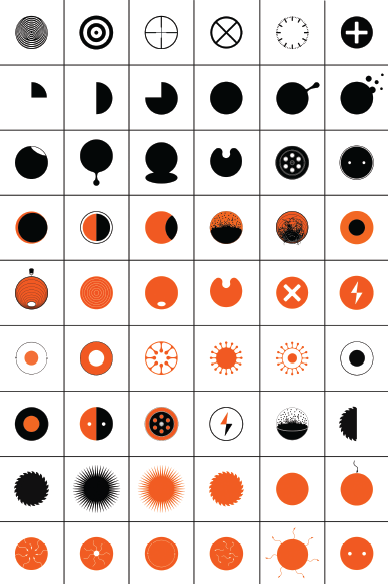 Kuba Woynarowski, Alphabet/ Alfabet, 2012
-
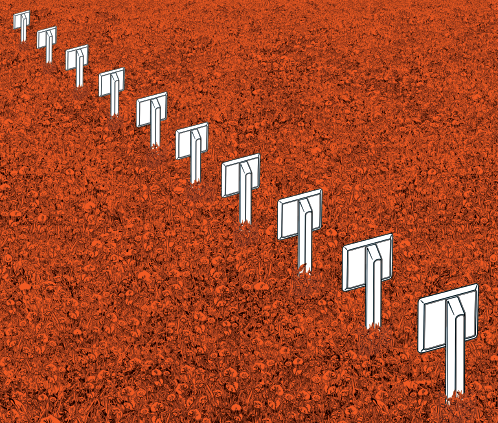 Kuba Woynarowski, Et sic in infinitum, 2012
-
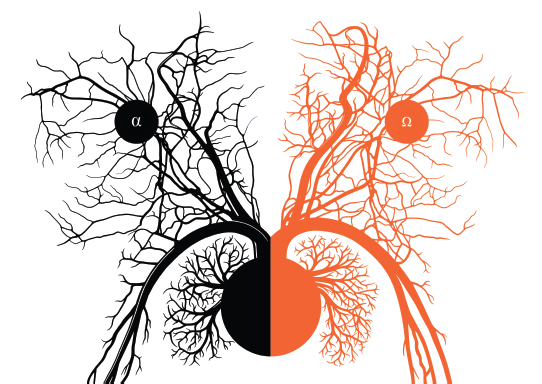 Kuba Woynarowski, Circulation/ Obieg, 2012

