
Texts of culture? A few words about the work of Rafał Bujnowski, Marcin Maciejowski and Wilhelm Sasnal Magdalena Mazik
“Visual culture opens to the entire world of intertextuality, within which images, sounds and space are read by each other, providing themselves with next layers of meaning and subjective answers. It can be found in movies, television, advertisement, art works, buildings or urban space. In a sense, we created the field for visual version of the Derridean difference and its attainment has a double result: it has influence on both the semantic structure and interpretation as well as the cognitive and institutional frames which try to embrace them.” 1
Tired of the abundance of visual messages, the eye of a contemporary pyknoleptyk is an exceptionally fastidious recipient. In the relentless stream of images, it is hard to impose concentration on him. “On the outside”, on equal rules, shop windows, billboards, advertising pillars, a play in a public space, trailers with advertisements, road signs and various flyers are in competition with each other fighting for attention. The sound-proofing of the overload is made in the interior where similar strategies of framing - from white cube to black box - are applied by boutiques as well as art galleries. However, it won’t be a pessimistic article about the condition of icon and audiosphere of the developing countries but about attempts of their artistic processing.
Small, black and white, noticed on somebody’s purse in accordance with the logics or rather poetics of the Barthes’s punctum. The badge with the drawings by Marcin Maciejowski present a woman complaining in an exhibition space: “This overload of images disturbs me.” The museum situation transferred to the urban space might be interpreted as a footnote (pin note) to the external, out of gallery reality. In this case, it’s also an exhibit teaching that the presence of creation of the former member of the Group Ładnie is complicated in the Polish landscape.
This topic was discussed by Bujnowski, Sasnal and Maciejowski a lot and there with many diagnosis made such as: from a story “about their own life”, “life of the generation which went through transformation”, “chronicle of social life in Poland”, to “reflection of the civilizational changes”. Let’s try to put in order the artistic activity according to mean of expression: images, slides, movies, comic strips, music but also “Słynne Pismo we Wtorek”, billboards of Galeria Otwarta AMS, murals inside clubs and the party performative activity of Group Ładnie (2) demonstrates the omnipresence resulting from versatility. Łukasz Guzek, while analyzing the art of artists graduated in the 70s, through the prism of the experience category (Dewey) and simulacrum (Baudrillard), indicated its “sense of connection with the world but also real participation in the live presence” (3) with all its disadvantages and advantages. Even though the poetic created by Bujnowski, Maciejowski and Sasnal, remaining very autobiographical, constitutes at the same time “a pictorial quintessence of mass culture and a synthesis of a particular visual cult which dominated Poland at the end of the twentieth century.” (4)
In this context, it is worth highlighting the comic book creation of Sasnal and Maciejowski. It could be compared to the automatic register of the first reaction, a quick sketchbook. Both authors provide simple messages, often terse statements, extracts or quotations with images drawn with a simplified line in a characteristic way. The human postures presented in black and white have only a general contour in order to be used at competitions where it is asked to invent and fill in the ready “speech bubbles” in the sketched scenes. It’s the text which individualizes the character and the minimalism of form in the clash with the word creates a joke. Even though in case of Everyday life in Poland 1999 2000 under the generalizing title there is a very individual and private story about the birth of Sasnal’s child, about their financial adventures and their everyday life, Maciejowski’s pictures (like the one from the badges) are scenes concerning rituals accompanying culture, sport and politics. Sometimes celebrities and recognizable people appear.
Texts on Marcin Maciejowski’s paintings come from television, newspaper, sport commentaries. In case of a series of works presenting only radio and comic book space with text, stopped by a hectic radio narration shows the schematism and language powerlessness. Similarly, if an artist includes dialogues in his paintings, he does it in a simple way, very often these dialogues have a phatic function. In Maciejowski’s works, a big part constitutes repainted film frames in version with and without subtitles as well as film preview from newspaper. Visualization which appears already filtrated by the text is post-conceptual, plays with the frame, taking into consideration both our way of looking as well as the circumstances which carry the source of the image itself: film or television frame, a newspaper scrap, system of frames or pictures.
The most interesting group is composed of works within which the character of the text doesn’t remain clear till the end. Its origin could be the heading but also a statement, a nostalgic plate asking about the icon creation. They refer to Andrzej Gołota or Adam Małysz but they aren’t people’s portrays. Are images such as Elżbieta Jaworowicz rozwiązuje problemy/Elżbieta Jaworowicz is solving problems or Krzysztof Rutkowski ściga przestępców / Krzysztof Rutkowski is chasing criminals really portrays? In these canvas, in the foreground we may see the title characters but in the characteristic television perspective. The images of Maciejowski recall Truizmy / Truisms by Jenny Holzer which under the appearance of stating obviousnesse, they ask about the borderlines of our acceptance of certain issues, of the quest for ourselves in the reality created by the media and its hierarchy. They ask questions if or rather when this kind of (our?) newspaper/ everyday television will not be up-to-date anymore. The revelation of the anachronism is not accompanied by a taunt but rather an unpretentious smile hiding an agreement to a situation, as the author reckons, “it’s more of a promotion than endorsement of reality.” (5)
The image creation is also a topic touched by Rafał Bujnowski in the series Portrety papieskie / Portrays of the Pope. His former work, instruction Jak namalować papieża / How to paint the pope was supposed to fulfill the demand of John Paul’s II portrays. A much faster tradition from the Orthodox one of writing icons present a couple of simple steps allowing how to individually effectuate a painting with the pope imagery. Portrays of the Pope, encouraging making an effort the spirit DIY, are unitary and unrepeatable. In the meantime, they constitute a proposition of an answer to the mass cult and the entire about-religious industry. The work Ostatni zachowany / The Last Remaining functions in a completely different way. We are put on the spot by watching the whatnot from the Family Home of John Paul II in Wadowice recreated by Bujnowski in a few exemplaries. The question of the role of mimetic art and of an artist creating material items is currently a significant issue in the works of Rafał Bujnowski from the beginning. The pope’s whatnot, which is indistinguishable from the original, might be considered as in fact what, that’s the question. A copy of the furniture, an antiquity or a relic?
In the accomplishment of Dzisiaj polecamy / Today we recommend, the artist addresses himself towards the objects of the lowest range of advertising boards situated in front of the stores. All of them are provisional, forced to everyday alternation and they belong to the market world. The advertisement from Today we recommend, additionally doesn’t knock down with the offer. It recommends basic products of which the bargain price might only minimally (proportionally to the bargain) lessen the necessity of the purchase. Today we encounter these kinds of offers; even before the paint on Rafał Bujnowski’s canvas managed to dry up, today we recommend what has already changed many times.
In the paintings from the series Graboszyce, the shape of the stretcher bar renders the block of the portrayed building. The titles of works are like rigid designators and they refer to real addresses in the village Graboszyce. The game between the totality and the concrete thing takes place not only between the exclusive form of a portray and the commonness of the presented architecture. The houses cleaned up of details become so typical that they seem to be familiar.
In this conceptual painting, the title rarefies certain works playing the role of the mediator with the museum surrounding and this way it allows an interpretation of the works in a new way. Sometimes it is even a direct indication leading our eyes. It is difficult to discern the character in the background in Whistler’s mother by James Whistler. Behind the figure of the mother, there is a modest beige-grey view with a boat. It’s mounted with a white passé-partout and a black frame. Simply the painting Whistler’s mother. Thanks to Rafał Bujnowski everybody can see it very precisely.
Since the beginning of the decade, works of Bujnowski, Maciejowski and Sasnal has belonged to the stream of the texts of culture. They are on gadgets and in newspapers, and they also exist in the language which they managed to reach. The works mentioned in this text (apart from Whistler’s mother) can be found at MOCAK exhibitions.
() I. Rogoff, Studying Visual Culture, in: An Introduction to Visual Culture, ed. N. Mirzoeff, second edition, Routledge, London – New York 2009.
(2) See. M. Drągowska, D. Kuryłka and E.M. Tatar, Krótka historia Grupy Ładnie, Korporacja Ha!art, Kraków 2008.
(3) Ł. Guzek, O sztuce praktycznej i praktyce artystycznej, „Magazyn Sztuki + Obieg” 2001, No 28, p. 15.
(4) A. Szczerski, Malowa Ładnie, in: Mistrzowi – uczniowie, Instytut Historii Sztuki UJ, Kraków 2001, p. 175.
(5) http://www.baltic-gallery.art.pl/archiwum/rybieoko/rybieoko.html [retrieved on 3.10.2012]
Magdalena Mazik (born in 1985) – a Ph.D. student of the Department of Anthropology of Literature and Cultural Studies at Jagiellonian University. She works at the MOCAK library. She cooperates with the Foundation Artists Innovation Theory and with Tarnogórska Foundation of Culture and Art.
-
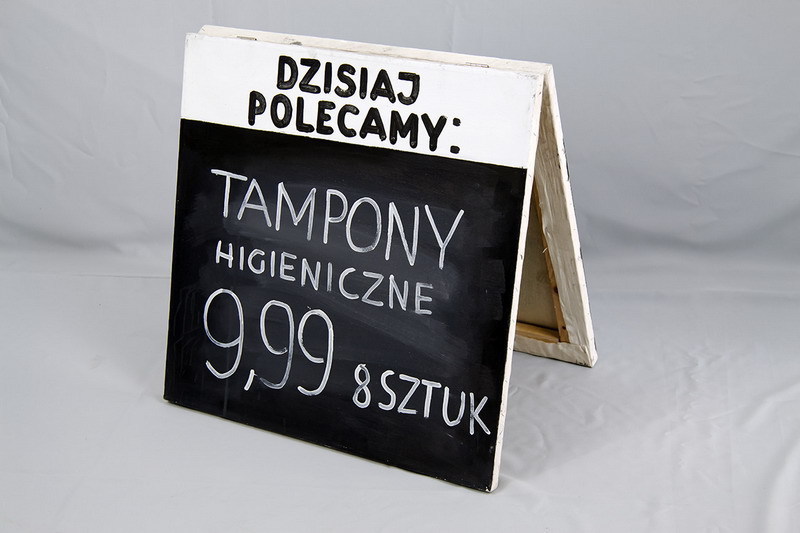 Rafał Bujnowski, Dzisiaj polecamy zapalniczki / Today we recommend matches2000, oil / canvas, MOCAK collection, phot. R. Sosin,
-
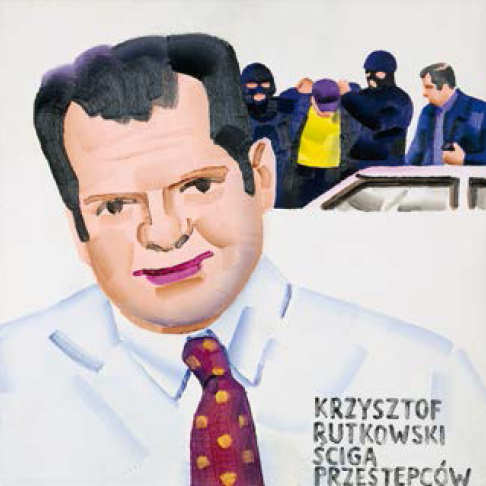 Marcin Maciejowski, Krzysztof Rutkowski ściga przestępców / Krzysztof Rutkowski is chasing criminals, 2001, oil / canvas, MOCAK collection, phot. R. Sosin
-
![Wilhelm Sasnal, Untitled [Apteczka / Medical kit], 2002, object, mixed technique, MOCAK collection phot. R. Sosin3](https://d1uip03pwa14dd.cloudfront.net/system/images/5424/be7da93fc5_large.jpg) Wilhelm Sasnal, Untitled [Apteczka / Medical kit], 2002, object, mixed technique, MOCAK collection phot. R. Sosin
Wilhelm Sasnal, Untitled [Apteczka / Medical kit], 2002, object, mixed technique, MOCAK collection phot. R. Sosin

