
Lemur’s transgression Jas Kapela
Prompter is a device without which we couldn’t live now. It’s difficult to imagine a modern world devoid of prompters. What would the everyday news be like without this secret box, hidden in the back, in the sweet consciousness of an even sweeter camera? The viewer wouldn’t bare the look of the broadcaster who instead of reading from the screen, pretending that he is referring directly to the source of all the facts, insignificantly supporting his/her elocutionary talent with a sheet of notes, instead of reading from the inside of the secret box (almost like a fortune-teller reading from the fish entrails, he would be formulating his own thoughts, what’s worse, he would be overtly reading from a paper. Pah, the viewer! A human! A human wouldn’t stand the look of the face of another person who was reading, overtly pretending that he was not reading.
Henri Michaux, in one of his arch-surrealistic notes, presented this in the following way: “It’s not the crocodile who should warn: be aware, the crocodile is approaching!” Then, he noted:” The man gets drunk for the first time and he cries bedazzled: what would the destilate from the entire world look like?” (1)
Precisely. Surrealism as a current exploring the underground inspires almost every underground (from Orfeus to rightish Internet forum). That’s why the bellicose approach which was precised by the most eager representatives of the artistic formation, even such as Antonin Artaud, insures the mental means for the incessant revolt.
Ergo, being inspired by the surrealism, let’s ask: what would the prompter of the entire world look like? Would it be a sum of all the advertisements, inscriptions, announcements, instructions, appeals, “exits” phosphorescing above the hatches of the space shuttle Earth, etc, through absorption nourishing the urban passerby (say Tadeusz Konwicki), who pretends that he doesn’t read and only because he is constantly browsing it in his head without showing it, just because it is digestible for his people? (2)
Or maybe the prompter of the entire world is a graffiti in Stygian gloom or an organism of a lemur? Most probably that’s what would William S. Burroughs state, especially taking into consideration that he rendered tribute to lemurs as to saint mutants.
As it is well known to everybody, both graffiti, emblematic Ancient Egypt, and lemurs as well belong to the components of the imaginary cockpit where Burroughs, a secret guru of adolescent agents of the middle-sphere (ask your kids about the author of Naked Lunch and you will evoke the due panic), directs the ephemeric, cult virus (his motto: Language is a virus from outer space”, he engraves many Halloween pumpkins). Well, Burroughs ameliorated surrealistic montage techniques and he announced the invisible generation. He proposed that every representative should carry a boombox and then take turn to record and emit, imprinting on the public phonosphere a peculiar sort of synergy hymn and a completely new outspread subjectivity. He patronized punks and villains. What’s more, personally he wandered around the city with the adequate markers and when he felt like it, he wrote intricate slogan on walls.
Burroughs studies anthropology. His kind “look from the distance” at the so-called wild and his panic fear of power are well visible. The writer became famous due to one story when he didn’t want to meet his old friends, and he was convinced they are the messengers of the Great Control. Allen Ginsberg saw it painfully for himself. This distrust might be a mutation or a splinter of an ambivalent approach to this question very alive, which is literature. On one hand a complete devotion for a cause, on the other hand consciousness that literature is the fundamental media of distinction, this artificial side of power, thus the variety of attempts of crossing borders of the cover and for example “inscriptions on walls”.
According to Mieczysław Porębski, crossing (i.e. transgression) is a constitutional quest of twentieth century. Professor Porębski is the title character of The Professor's Penknife by Tadeusz Różewicz who is the author of the text under the title Napisy na ścianach / Captions on Walls. The work, rich in doubts such as whether the cockroach resembles a dog, treats about the need of the participation in a raw return to the silence celebration. This trend in literature was set by figures such as Beckett, Blanchot and Celan. This confession is inspired by the journey along the Paris walls in May 1968. The poet passes by the inscriptions kept in the convention of magic spells such as “Human isn’t neither stupid not intelligent, is free or isn’t.” [1] In order not to forget, he writes down the slogan “art is shit”. He is miserable: made-up with a red lipstick, tar and a pencil. Poems? Dramas? A man of letters?” (3) It’s a good question.
Różewicz came from a country where a man of letters was an exceptional figure. Jerzy Urban highlights it: “Who can be published, praised, dispraised, titled a writer. Those were solemn political affairs. It happened independently from the fact how many real men of letters write and publish books or how many people read them and whether they have any influence on anyone or anything. Literature was a mythologized domain. Its creators were an invented problem in order that the government could trouble about the untrue problems.” (4)
Additionally, there were a couple of those who showed their biggest talent, preparing reports besmearing the companions of destiny from their environment (this perverse creation in a particularly nuanced way was described in the Ostatni raport/ Last report by Zbigniew Kruszyński.
No wonder that the first vanguard of the free Poland (brulionowcy) was directed by mistrust, both to the older collegue as well as the entire literature, that’s why they addressed their young friends, skateboarders. To the survey “Pisarze przecenienie/ niedocenieni”/“Writers Overestimated/ Underestimated” conducted by the editing desk of “Kultura” in 1992, the top representative of brulionowiec movement (today a pious suppressor of homeopathy) Robert Tekieli says: The street poetry (graffiti) is unappreciated where there is the most truth about emotions and minds of people living in this country than in almost the entire poetry and prose of the recent years. Graffitti (pars pro toto of alternative activities) fulfills the basic function of culture of domesticating the reality.” (5) Today we could say the same thing about the internet memos.
Burroughs, supporting himself with the example of hieroglyphs, reminded that writing is an image so writer is a painter, an artist at full stretch. Just like a prompter.
(1) H. Michaux, Slices of Knowledge, w: Poems for the Millennium: The University of California Book of Modern & Postmodern Poetry: From Fin-De-Siecle to Negritude, ed. J. Rothenbeg, P. Jorris, University of California Press,Berkeley 1995.
(2) T. Różewicz, Proza, Ossolineum, Wrocław 1973, p. 557–558.
(3) Ibid. P. 558.
(4) J. Urban, Alfabet Urbana, BGW, Warszawa 1990, p. 184.
(5) http://www.niniwa2.cba.pl/pisarze_niedocenieni_pisarze_przecenieni.htm [retrieved on 4.10.2012].
Jaś Kapela (born in 1984) – poet, prose writer, columnist and member of “Krytyka Polityczna” (a left-wing political movement and an editing house). Author of two books with poems (Reklama and Życie na gorąco), two novels (Stosunek seksualny nie istnieje / Sexual intercourse doesn’t exist and Janusz Hrystus) as well as a collection of essays Jak odebrałem dzieci Terlikowskiemu/ How did I take my children from Terlikowski. He won in the first poetic slam and the following ones in Poland.
-
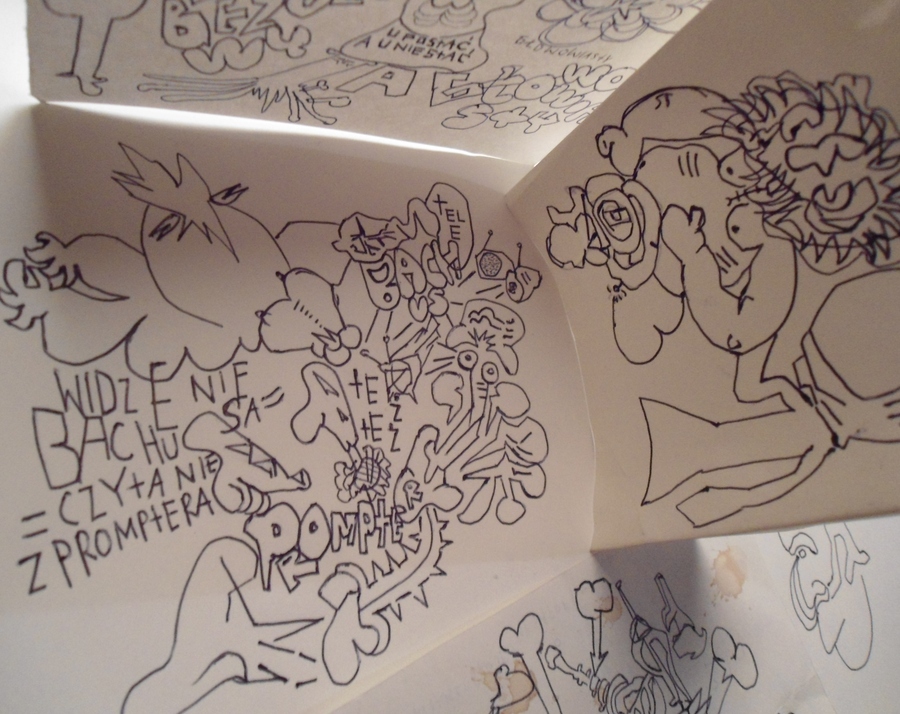 Andrzej Szpindler, telebach, 2012

