
I believe in books An interview with Sebastian Cichocki about art locked in books- Katarzyna Wąs
Katarzyna Wąs: What is a book for you?
I have to admit to quite an emotional relationship with paper. I feel much better when I am surrounded by books. I have never possessed too many objects to which I was so attached that I could carry them when I move out. Books are an exception. The collection which I currently have is of a great potential for me - I have not yet read a big part of the collected books. I usually buy them "to read afterwards" and then I discover them anew after some time. Frequently it turns out that something long sought after is at my fingertips, for example a reading to a lecture I prepare at that time or and an exhibition. Every now and then, of course, I am trying to get rid of some books, and then again I begin the treacherous process of accumulation.
And then you sell them?
No, I give the books to the reading rooms of the museums, or I give them away to friends. I try to be ruthless during the selection process. However, it does not prevent me from uncontrolled stacking of the books in the house. They are spreading at an alarming speed, especially on the windowsills. I try to control it, not bringing home the books I read only once. Unfortunately, it excludes most of the literature. The center of gravity is moving more and more towards anthologies, reference publications, which I use when I am working on exhibitions and my own publications.
Yet the books are still piling up?
The view of books on the shelves calms me. I think there is something disturbing in houses where there are no books at all.
What does your library look like, then?
I try to make all the books fit on just one wall. These are the publications mainly related to art of the twentieth and twenty-first centuries, with an emphasis on categories that are necessary for my work. Inevitably, museology is strongly represented in my home library. A lot of books relate to land art and conceptualism, sound art - the art movements I am interested the most. There is also a lot of "theory of…" books that are not necessarily connected with art, but rather the history of science, experience, cabinets of curiosities, etc. The section of artistic fiction is also steadily growing. I am trying to make my bookcase a kind of "mind-map", which reflects the issues I will work in the coming years. This was the reason to build the MDF-bookshelves across the longest wall in the apartment, designed exclusively for books. For the time being, the war with books seems to be lost – there is no room for them.
Do you think that there is an overproduction of books?
The overproduction of books is the weakness of our environment. The institutions of art are compulsive squanderers of paper. Imagine that every time a new species of fish in the region of Great African Lakes is discovered and described, a publication comes out! In other scientific areas there is no so much pressure, and the articles in academic journals suffice. Meanwhile, the institutions of art take as a point of honor to issue a publication of every new exhibition. As a result, each year we get, for example, several new catalogues of Wolfgang Tillmans. There is a difference between a well-thought-of artistic book, based on an intelligent concept and a thoroughly predictable exhibition catalog. Many galleries and museums, however, are aware of the impasse in which the institutionalized publishing activities are in, and start looking for new formats, they start to experiment.
You run a blog about thought-provoking books in an interesting form of a memoir...
This blog was created as an online extension of artistic activities of a bookstore, a branch of Berlin Pro qm, which operated in our museum. It was a "curated" library, something more than just a book shop - activities that were organized was like a sequence of exhibitions, made from carefully selected configurations of books. After some time, a blog that took the name “M is for Books” has become a place for more private records, where, however, I continue to concentrate on art books.
The posts on your blog have little in common with traditional reviews...
There is not much space for critical essays or reviews. This blog has its own, slow and irregular pace. It is rather a blog about how to live with books, how to travel with or towards them, or how one can discover books in unexpected places. Books that I describe on the blog are photographed in their “natural habitat”, that is in places where they are read: outside, in bed, on a plane, etc. I think it is a niche proposal and this blog has a rather narrow group of readers.
Books are for you both a refuge and a threat of collapsing bookshelves, but they are also a material for your work...
Undeniably, books are basic material for my work as a curator and critic. At some point, I also discovered that books can serve not only as a source of inspiration for curatorial projects, but also they can be used as an exhibition space. A book can be a fully-fledged and autonomous space for exhibitions – white pages as the exhibition architecture. This reflection was one of the most important turning points in my curatorial work.
How did it happen that you closed an exhibition within two covers?
It was a side effect of fatigue of a typical catalogue format for exhibitions and texts, which are subordinate to it. Critical essays published in catalogues are one of the most repulsive forms of writing that our environment developed. I am also guilty; I wrote dozens of such texts. I am trying to get out of this impasse, at some point I started to suggest to artists who invited me to work on catalogues a sort of a game – writing texts in a more literary, fictional character, where references to the artistic practice of individual artists are hidden, and historical and artistic clues and references are vague and veiled. I am absolutely convinced that these texts should be treated as fully-fledged exhibitions; we have to carefully arrange them, think in terms of space and relationships between objects.
So, from a story to an exhibition?
And sometimes from an exhibition to a story, as it was the case of an unrealized project of Monika Sosnowska, the only trace of which was my fictive text in “Between Walls and Windows”. Robert Smithson, whose actions and texts are for me a source of inexhaustible inspiration, wrote often about the collision of mind and matter, two major forces in art that act on each other, destroy each other, but they cannot exist separately. In 1966, Smithson drew “A Heap of Language”. He placed a heap of scattered words on a graph paper, they were words related to linguistics, such as "syntax", "noun", "neologism". It is a beautiful work, illustrating the idea that a language undergoes the same geologic processes as rocks, that is erosion, desquamation, and delamination. Together with Łukasz Jasturbczak I am currently working on the novel “Mirage”, and it is largely a homage to Smithson and his hypotheses.
How is such an exhibition in a form of a book made?
Like other exhibitions. First, I ponder over certain topic, looking for relevant works and presentations. The only difference is that the starting point of the exhibition is the blank page of a potential book, and not the exhibition hall of an institution. In fact, the difference is marginal. There are many books which can be read as a set of instructions to a potential exhibition, for example Locus Solus by Raymond Roussel. The exhibitions that I realized in the form of books are primarily a result of my fascination with oral stories and role of communication in the process of constructing the history of art. I am interested in what is forgotten, poorly stored in the course of writing and re-writing of artistic canons. The result was, for example, "The future of art criticism is fiction"/ “Przyszlość krytyki artystycznej to fikcja” on which I worked with a large group of authors who share a fondness for creating fiction as a form of curatorial work. They constructed the exhibition text, taking the form of science fiction stories, parables, poems, fragments of correspondence with a fictional artist. The exhibition that was created in this way included 19 works and was "an exhibition consisting of exhibitions."
How do you find yourself in such a space?
In the above-mentioned case, the “space” of the book corresponded with the potential museum space. Each chapter was one of the "rooms", while short poems written by the Raqs Media Collective were the "passages" between them. So you can imagine a situation in which you wander the empty museum, where there is no tangible object. On the walls there is a text. Partly, these texts help to navigate in between the halls, but they mainly help to fill them with objects.
And what about a project Open throne/Otwarty tron carried out together with Agnieszka Tarasiuk?
This is an example of an exhibition that became a book, contrary to the original intentions of its authors (1). At the moment, when it became clear to us (we worked in an interdisciplinary team), that the realization of the exhibition in the form that we imagined is not possible, and a visual "evidence" is not convincing, we decided to look for another solution. The result was some very interesting texts. We have also gathered a lot of iconographic material, and the book seemed to us the most honest and natural way to deal with this issue. The publication serves as a mobile exhibition, and at the same time it is a confession of guilt and reflection on the inability of art to critically revise some views or dogmas.
Could art be shown to viewers only on paper?
Yes, of course. I do not think there is anything exotic in presenting artistic projects only through publications, without parallel materialization in the form of an exhibition. The character of Seth Siegelaub is particularly important for me. He was a curator and agent of the conceptual artists and he revolutionized the way of thinking about formats of art exhibitions in general, but also about the relationship between the exhibition and its accompanying publication. He organized, for example, the exhibition “January 5-31, 1969”, which, as he wrote, was only "a guide to the catalogue"! This exhibition was organized in a rented office space, and apart from a chair, on which the visitor could sit and watch the walls, looking for hints and clues; there were no tangible works of art. What the viewers had to know was in the publication.
That brings us to the problem of a book as an art object. Did all begin with conceptual art?
There are some prior art books related to activities, of for example, surrealists. However, it is recognized that "the first modern artistic book" was released in 1963. It was “Twentysix Gasoline Stations” by Ed Rusch, who put the pictures of gas stations photographed during a car ride from Los Angeles to Texas. Nevertheless, a real publishing boom took place in the late 60s. There are several reasons why the art book started to be a common form of artistic expression. The first reason is very prosaic - the spread of low-cost printing services enabling the printing of color photographs. The second aspect is related to the revolution in the field of the art itself, which was becoming less and less material. Thus, a greater emphasis was put on the documentation of art. It required a development of a new relationship between artist and a photographer, graphic designer or typographer who documented the work of art.
Art was supposed to be realized outside of an institution. And what about the audience?
To many artists in the 60s it was important to get free from the cycle of institutional rituals and the market of art, which has also led to a loosening of ties with the audience. Much of the legendary works of that time was rather ephemeral, art happened without being witnessed or only in the presence of a small group of friends. At the same time there were various forms of "printed” expression – posters, manifestos, interventions in the newspapers, and finally art books. They could circulate more freely than works presented only in the gallery spaces. Text began to play a very important role – either in the form of photocopied instructions, or in the form of a neon or slide. Since that fixation on the text, which seems to be natural consequence of the dematerialization of art works in the late 60s – it was close to the fascination with a book as a new, alternative exhibition media.
In recent years, a return to this type of practice is visible...
Yes, the artistic publications are often first-rate. Many institutions move away from issuing schematic catalogues to well-designed and edited anthologies of texts and art books. There are also independent initiatives, like excellent publications of Morava Books publishing house. The most beautiful exhibition in a book form that I happened to see recently was Adventures on a desert island / Przygody na bezludnej wyspie by Maciej Sieńczyk. Of course, you can claim that it is a comic book or a graphic novel, but I treat this book as a fine, old-fashioned and decadent exposition with excellent arrangements of objects, exhibition architecture, textures of walls, colors. Sieńczyk is a very efficient curator; he uses the works of non-existent artists, whom he brings to life.
So how do you see the future of books?
I would never replace books by the gigabytes collected on a hard disk. When it comes to paper, I am very conservative. I think that in 20 years, I could have a problem with using a e-book due to the amount of formats and media available, while I am convinced that paper will survive intact for centuries. Maybe that is why the presence of books in my house is so reassuring.
(1) The project concerned the reception of the figure of John Paul II in the field of contemporary art. The result was to be an exhibition at the House of Creative Work in Wigry.
Sebastian Cichocki (born in 1975) - a sociologist, curator and art critic. In 2005-2008, the program director of Kronika-Center of Contemporary Art in Bytom, currently a deputy director of the Museum of Modern Art in Warsaw. He is an editor of the magazine "Format P" and author of numerous publications, including a book for children “A.R.T / “S.Z.T.U.K.A” including stories about contemporary art. He runs a blog about books “M is for Books”: http://muzeumproqm.blogspot.com/
-
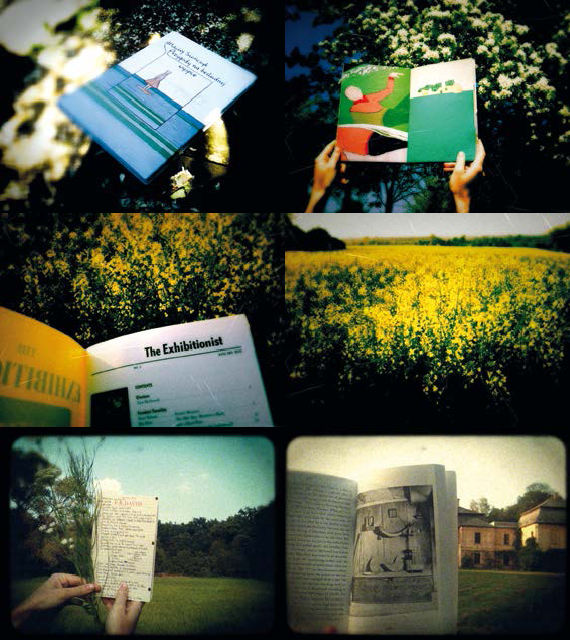 Pictures from Sebastian Cichocki’s blog: http://muzeumproqm.blogspot.com/

