
Cartography of unknown places Szymon Maliborski
An encounter with Piotr Rypson’ book by We Are Not Geese: Polish Graphic Design 1919 – 1949/ Nie gęsi. Polskie projektowanie graficzne 1919–1949 can be seen as a sort of adventure. The book is not an atlas of geography, but a map metaphor, to which the author refers and encourages to explore the content as an unknown land. This land is a significant area of graphic design in Poland, described slightly differently than it used to be done, both in terms of temporal and thematic approach.
The first novelty of the publication is the time frame. Leaving the rigid division of the Second Polish Republic, the author extends this period for ten more years and considers it as a whole. This is because the trends and solutions of design, as well as the world that needed and created them lasted until 1949, when all existing publishing houses underwent nationalization, and socialist realism became a dominant trend.
The second novelty is the range of interests, the extent of matters the author appreciates and what he wants to preserve: ranging from banknotes’ projects, official government commissions and state identification, to bills and advertisements. Rypson tries to trace the expansion of iconography of consumerism, development of advertisement. He shows the examples of printed agitation works, propaganda brochures and covers of prose issued on a massive scale. In other words, the subject of his book is the universum of visual culture, in which one can trace a marriage of text and image, the visual everyday life of streets, shops, factories, as shown in graphic design. This is not, in any case, a review of the avant-garde typography known by its achievements. This is a monograph work about mundane but significant interference of utilitarian projects with real life. We move from one sphere to the other getting further examples, in the rhythm of a monotonous at times travel we reconstruct the image of the époque. We can learn not only about the aesthetic predilection of different environments, but also about political tensions and antagonisms. Certain ideas and groups that represented them hid into readable forms indicative of progressive or conservative camp.
Given the instability of such objects and their utilitarian character, the fact that apart from the Poster Museum there is no institution engaged in storing them, this book as if restores them to public circulation. It re-discovers the unknown visual space supplementing our knowledge that was limited to the knowledge of the achievements of the greatest artists. In addition to Strzemiński, Przyboś, Szczuk and Stern, as well as the results of their collaboration (being part of the canon of typographic art history, as in the volume From afar / Z Ponad and a poem Europe), the book reminds of those "small masters" setting trends for mass production. The book reconstructs the process of creation of modern graphic design, but is not governed by a linear narrative; it is more a typology and a grouping of examples.
Hence emerges both strength and weakness of this publication. Unquestionable cognitive value of it is redeemed by numerous relapses, repetitions and, as mentioned, a monotony of descriptions. Shuffling the order or removing one of the middle chapters would be rather unnoticed. However, this is not a vaporized distillate in the alembic, but rather a compilation presenting – as far as possible – the full range of more or less interesting examples. Therefore, such a form of the book seems justified.
We Are Not Geese: Polish Graphic Design 1919 – 1949 is a type of document which summarizes the growing saturation of image in different aspects of our lives. The proliferation of visual stimuli goes hand in hand with the process of modernization. It's not only about the development of the new aesthetics. Trying to build a new visual language has always been an indicator of the modernity of state, and in the radical avant-garde approach – a demand for the construction of a new reality.
Szymon Maliborski (born in 1986) – a graduate of History of Art, at the Jagiellonian University, he currently studies Polish Studies. He is a member of the artistic-theoretical group Roboczogodzina. A curator.
-
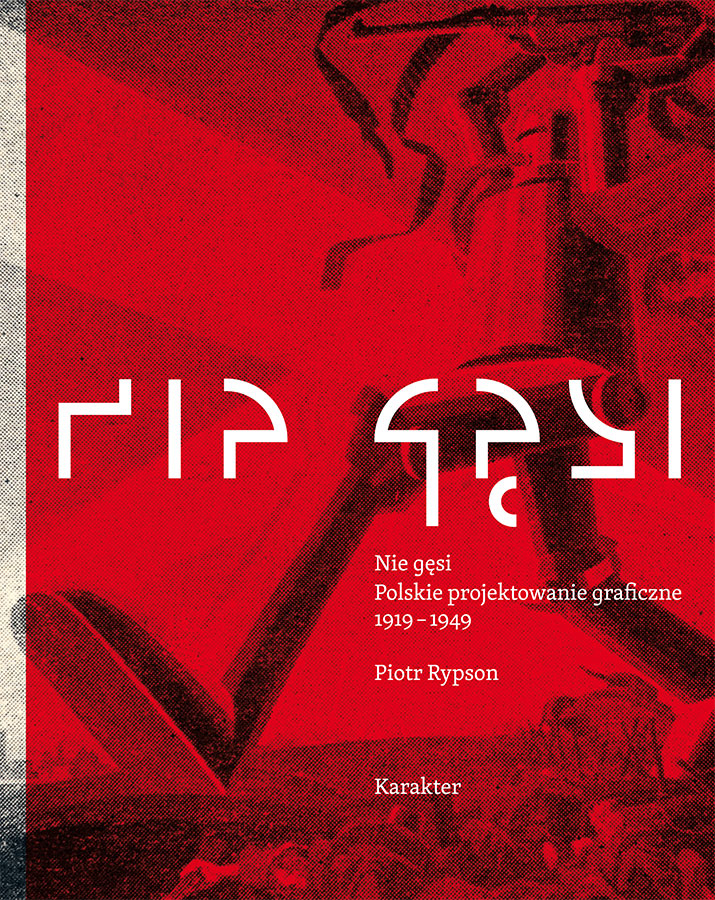 Piotr Rypson Nie gęsi. Polskie projektowanie graficzne 1919–1949 / We Are Not Geese: Polish Graphic Design 1919 – 1949 408 pages Karakter, Kraków 2011 ISBN 978-83-62376-09-4

