
Bite a book Project Return of the book Emilia Pawłusz
In the antique book store Skrypt, situated in the tenement at Jabłonowskich street in Krakow, there is a big carton box with discounted old books which can be purchased for a couple of zlotys. I know this antique book store very well from my university times. Students always constituted the most faithful group. The characteristic box with unwanted books has become the inspiration to pose a question about the social significance of books, their relations with the reader, the space where they function, and the process of commodification which they are subject to. Our intention is to find a book in this urban mess of globalizing, urbanizing madness of capital. (1)
Thanks to this research, an artistic-social project was born under the name which was accomplished from March to May 2012. Its conception and realization was a common action of the team of the Education Department – Elżbieta Sala, Maria Wegenke, Emilia Pawłusz and Magdalena Mazik who created the programme of MOCAK Library, the Krakow project Sól (2), conducted by Mateusz Okoński i Aneta Rostkowska, and the antique book store Skrypt. Every person involved contributed a different point of view to the project, the action unified many different milieus, ideas and perspectives. Thanks to the project Sól, Return of the book! has become an artistic action socially involving, touching the topics of transformation of the city, disagreement with gentrification and commodification of the local identity where little service points such as the antique book stores are the anchor.
The role of the antiquary was to choose and rent a several dozen of books which were transformed by artists and workshop participants at MOCAK. The Museum Library has become the space for the realization of the workshops and the exhibition of its effects – artistic books of which the exhibition inaugurated the activity of the Reading Room of the Museum. At the end, Education Department set a participatory character to the event by inviting people interested in exploring the Museum and the creative and unusual, very brave interaction with books.
The project had a character of a multistage and, in a sense, it still lasts. On 31 March, at the MOCAK Library open free workshops took place whose participants learned about new forms of artistic books created by contemporary artists, and then among the books donated by the antique book store, they were choosing those which they wanted to change themselves. Old forgotten publishing houses have become something of a sort of material for creators. Participants of the workshops built their own relation with the object by their artistic interference. The key role in the workshops was played by emotions. It concerned the deconstruction of a certain myth around books, breaking taboo of its irreversible destruction. It turned out that it’s not necessary to read books in order to experience them because you can play with them and experiment – draw on them, glue something on them or tear out pages, cut out, burn, bite, write down more, colour, sew. The transformed books were signed. It happened that one book was modified by a couple of people by accident. MOCAK team together destroyed one book.
In the workshops, there were different groups that took part – families, children, teenagers, students, seniors, artists, professionals related to books and visitors at the Museum who wanted spontaneously join the action. Everyone could play the role of the creator, observer and recipient of the actions of other participants. The modified publications were returning to us the next couple of following weeks after the end of the workshops. In total, there were 60 publishing houses modified coming from the antique book store and the MOCAK reference library.
The next step of the project was the exposition of artistic books in the Library Space. Mateusz Okoński designed and made the installation referring to a carton box – place, where the discounted books were placed. The visitors at the Library were invited to an interaction with the book, not necessarily to read them but mainly to touch, smell, find a connection with the artistic work.
After the April exhibition, the books came back to the antique book store Skrypt and that’s where our participation has finished their new story. They were available for a nominal fee, before they were transformed. We know that they enjoyed huge popularity and they found customers immediately. My favourite book, book-sculpture, was closed once and for all by soaking it in wax.
The project relieved a lot of social energy and enthusiasm. The participation of many diverse groups and different millieus showed the enormous need to create urban grassroots initiatives.
“City is a space courageously transformed by the human in accordance with the voice of the heart” 3 (nie ma przypisu). The role of new institutions of culture is to create an open space for socially engaged actions resulting from the needs of its users. The project Return of the book! allowed the meeting each other, creating new contents, sharing them, commenting on them and integrating around them by many different age and social groups. A very important element of this action was its local character. At the Education Department, we realize as well the Podgórze Project within which we want to react against uncontrolled gentrification and the effacing of the place identity where the Museum is situated. The return of the book inspired a couple of other actions – in July 2012 Magdalenia Mazik and Katarzyna Wincenciak proposed the next game with book in the main role but this time in a form of an exhibition. Read more >>> at the MOCAK Library. The exhibition encouraged leaving the traditional, classic order of browsing the reference library and starting an individual personal discovery as well as adding new contexts of the publication. The experience of the book has become the fundament of the workshop cycle for the youngest, entitled Dziecięca pracownia książk/ The Chldren’s Book Workshop. During these workshops, children were preparing illustrations to the book What is Art? and they designed colourful letters which they cut out afterwards. They placed them on cards of a specially prepared two meter installation in a form of a book. Certainly it’s not the end of actions inspired by books at MOCAK.
(1) See D. Harvey, Bunt miast. Prawo do miasta i miejska rewolucja, Bęc Zmiana, Warszawa 2012, p. 15
(2) Sól is an interdisciplinary project realized in the space of Krakow, aiming at drawing attention to the fact of the disappearance of small service points identifying the city. See Artysta wykańcza miasto/ Artist is finishing up the city, „MOCAK Forum” 2011, no 1;
www.sol-krakowska.blogspot.com
Emilia Pawłusz (born in 1987) a graduate of sociology at the Jagellonian University, a Ph.D. student at the Faculty of Philosophy at Jagellonian University. A holder of a scholarship of the Swedish Institute. In 2011-2012, she worked at MOCAK at the Education Department, responsible for the coordination of the Project Podgórze.
-
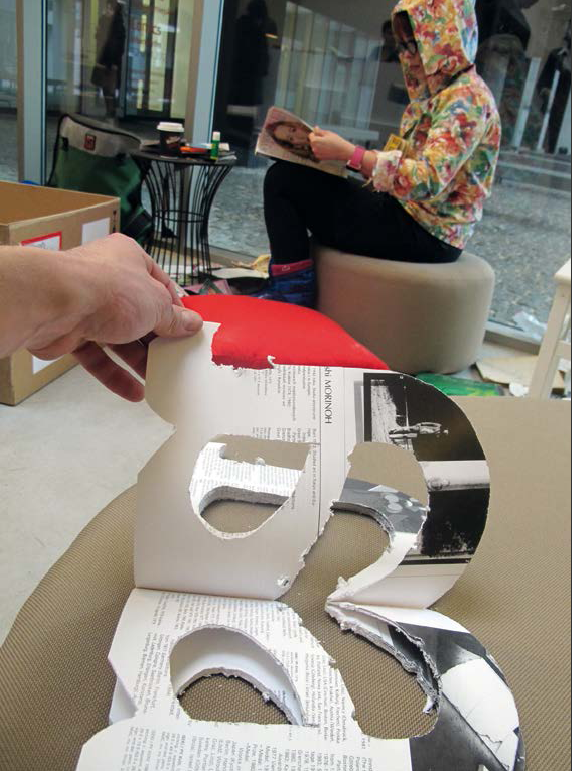 Project Return of the book! phot. K. Wincenciak
-
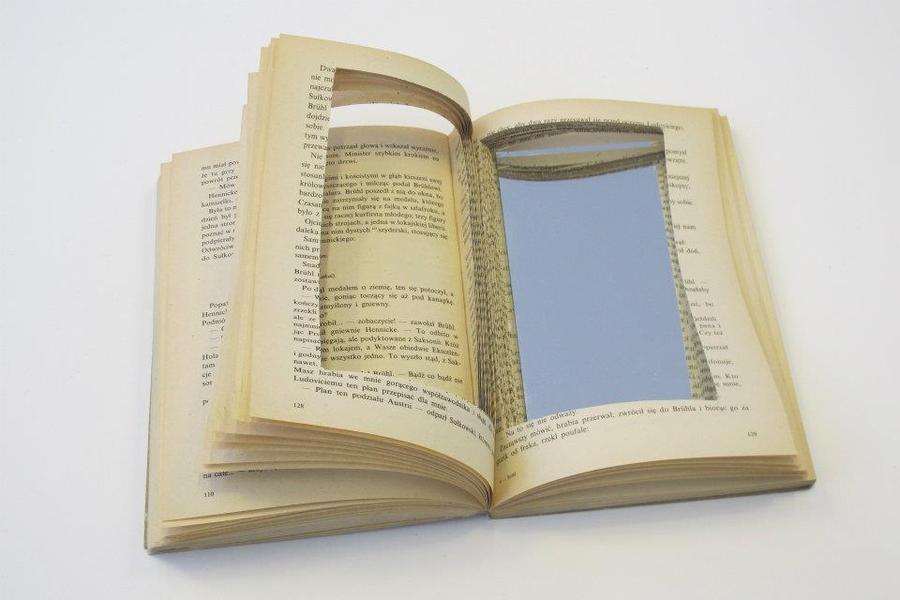 Project Return of the book! phot. K. Wincenciak

