
A tough nut to crack About books for the youngest ones Małgorzata Kuśnierz
The market of children's books can be compared to a bottomless well. It suffices to walk into a first bookstore encountered on your way, or even a supermarket, to realize that there are hundreds of thousands of children’s book. Most often, these books are easy to "produce", which is done on a massive scale by various second-rate publishers. According to them what is needed for a children’s book is a short story, or just a "repeated" story from the children's classics and a decent, colourful and infantile illustration. The target reader of such an offer is not only a child, but also parents who buy a particular book assuming that it would be suitable for their child only for a short while. Fortunately, there are some niche publishing houses that publish not only for profit, but according to their own tastes. In this sense, such publishers protected the market from an overspill of poor quality publications. Among these first-rate publishers one can surely name: Dwie Siostry, Wytwórnia , Czerwony Konik, Hocus Pocus, Format, Tatarak, EneDueRabe, Zakamarki and Muchomor. They value content, discuss challenging topics, publish unique articles, pay attention to form, and usually cooperate with illustrators and artists.
An illustrator can be a craftsman duplicating the most popular techniques and ideas and working at the client’s bidding. However, he can also establish his own, unique style with recognizable techniques, making publications of artistic value. In recent years many such illustrators emerged on the market. Interestingly enough, they usually produce books for the youngest children.
Neonatal researches show that the new-born children discern highly contrasted colours, best black and white. A series of cardboard books, Through the eyes of a child, / Oczami maluszka was created taking these results into consideration. The books contain only black and white, simple illustrations. The cardboard publications are aimed by the ambitious publishers to a bit older children. Their formats range from the smallest ones, fitting an adult’s hand, up to A4 format. Cardboard is more resistant to crushing, tearing and biting than paper, and a child’s fingers can flip thick pages easily.
In the offer of the publishing house Dwie Siostry, there is as many as 15 cardboard books. Because of exceptional, witty drawings that can surely develop a child’s imagination. The noteworthy positions are The town of Mamoko/ Miasteczko Mamoko and Once upon a time in Mamoko/ Dawno temu w Mamoko by Aleksandra and Daniel Mizielińscy. Through illustrations, these books tell the stories of the residents of Mamoko, what encourages the children to develop their own narratives and to use their own imagination. At the beginning of October 2012, the publishing house Dwie Siostry published also in A4 format, Maps/Mapy and Mamoko, the books authored by the same marital-artistic duo. Curious toddlers, travelling with their finger on as many as 51 drawn maps, will find out for example what various countries are famous for, where certain animals live, what people eat in different parts of the word, etc. At first glance, the illustrations seem to be overloaded, but it turns out that reading them together with parents can be an exciting way of spending free time, and also a way of learning through play. Ola Cieślak teaches the children to count animals. They are drawn with light colour crayons, with a childish-like line, imitating the drawings of nursery school children. On the bookstore shelves Ola Cieślak’s book From 1 to 10/ Od 1 do 10 is often positioned next to From A to Z /Od A do Z by Janusz Minkiewicz, so far the only, "cardboard" reprint from the past (1959). Appearing to be schematically drawn and almost colourless, the bears of Agata Królak’s Różnimisie are easily memorized by children and easy to draw on the paper. The illustrator proved that the simplest form can be best understood and can help the children to learn the basic antonyms.
Another illustrator, Katarzyna Bogucka, graphically developed a well-known poem by Julian Tuwim About Mr Tralaliński/ O panu Tralalińskim (Publishing house Wytwórnia) in an innovative way. The illustrations, inspired by the design of the 50s and 60, make use of a limited green, black and orange colour palette. While one might wonder whether these images are aimed at children (1), and not only at their parents who remember the communist times of People's Republic of Poland, one thing is certain – the illustrations are undoubtedly not infantile.
The children learn aesthetics from their earliest years. Many parents became convinced about that by the publishing house Tatarak, whose publications by Eric Carle are more and more popular in Poland, and are addressed to the youngest readers; or rather the youngest “users” of books, for one can play with these books in multiple ways, e.g., in a guessing game. These are the cardboard masterpieces, in which the form impresses at first place – with the collage technique the artist creates unforgettable images - but the books are also exceptional in terms of content.
Eric Carle introduces children to the world of words and numbers (My first book about numbers/ Moja pierwsza książka o liczbach, My first book about words/ Moja pierwsza książka o słowach), he tells the story of a very hungry caterpillar (A very hungry caterpillar, Bardzo głodna gąsienica) or of a mouse that is looking for a friend among various animals, (Do you want to be my a friend?/ Czy chcesz być moim przyjacielem?). Each of these books has a unique concept, sometimes even an interactive character - for example the books teaching the words and numbers are divided into four segments, which can be repositioned in any way, choosing an adequate description to the drawing. What is interesting is the form of the book about a caterpillar – pages on which different propositions from the caterpillar’ menu are presented are of different size and have holes (as if eaten out by the caterpillar), what encourages the toddlers to play with it.
Another illustrator who introduces unique graphic and typographical solutions in her cardboard books is Aleksandra Woldańska-Płocińska, whose very colourful and very readable illustrations are aimed at children between the ages of one to three years (First birthday of a Piglet/ Pierwsze urodziny prosiaczka, Numbers/ Cyferki, and published in November 2012 Second birthday of Piglet/ Drugie urodziny prosiaczka). Her publisher, from Krakow, Czerwony Konik, can also boast about A walk/ Spacer by Marta Liszka. It is a book made in collage technique out of colourful papers and it can be folded like a harmonica.
Last, but not least, one should mention Ewa Kozyrze-Pawlak who creates, out of fragments of fabric, a unique and almost giving an impression of a real texture, illustrative quilts (including The Train is Coming From Far Away/ Jedzie pociag z daleka by Muchomor Publishing house.
Anyone who carefully analyzes the illustrations of those unique publications would agree that when a child grows out of cardboard form of the book, it will be very difficult to say goodbye to them, and these books may inspire even teenagers. To what? To think and create in their own way.
- 1. In August 2012 at the New Theatre in Łódź, there was the exhibition of her books’ illustrations under a meaningful title Not- childish illustrations / Ilustracje niedziecinne.
Małgorzata Kuśnierz
(born in 1983) - a graduate of Polish Studies, Jagiellonian University (majoring in cultural studies). She works at MOCAK as an editor in the Publishing Department and co-ordinates workshops for Children – Playing with books. She cooperates with the magazine "Zwykłe Życie”/ “Regular Life", the quarterly “Tytuł Ujednolicony”/ "Title Unified”, as well as with several publishing houses (including W.A.B.).
-
 Eric Carle, A very hungry caterpillar/ Bardzo głodna gąsienica, Tatarak, 2010
-
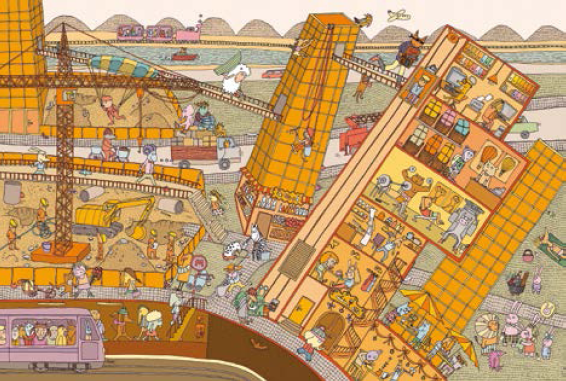 Aleksandra i Daniel Mizielińscy, The town of Mamoko/ Miasteczko Mamoko, Dwie Siostry, 2010
-
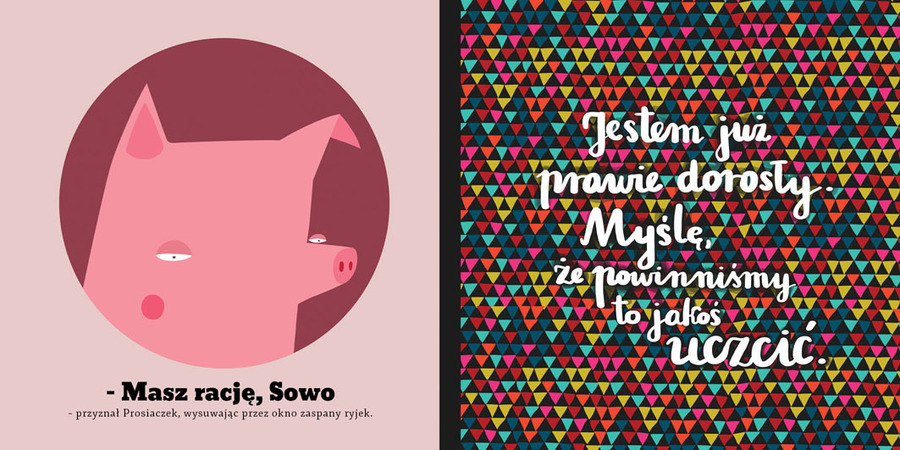 Aleksandra Woldańska-Płocińska, Second birthday of Piglet/ Drugie urodziny prosiaczka, Czerwony Konik, 2012
-
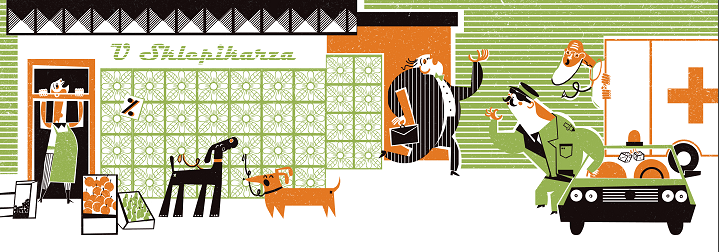 Julian Tuwim, About Mr Tralaliński/ O panu Tralalińskim, illustrations: Katarzyna Bogucka, Wytwórnia, 2010
-
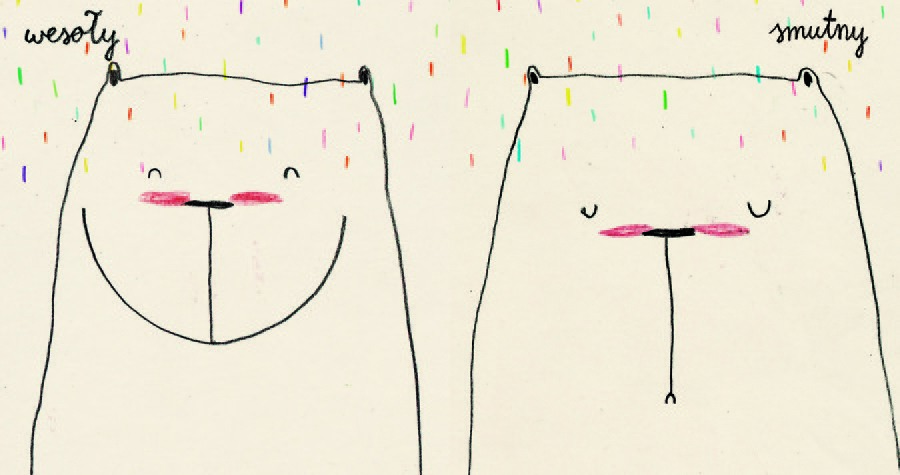 Agata Królak, Różnimisie, Dwie Siostry, 2012

