
A Czech phenomenon An interview with Andrzej S. Jagodziński about Czech culture and identity
Łukasz Grzesiczak: For many years you have been working as a correspondent and diplomat. Today you work at the Polish Institute in Bratislava, earlier in Prague. You are also a translator of Czech and Slovak literature. When did this passion for the culture of our neighbors start?
ANDRZEJ S. JAGODZIŃSKI: I have made some conscious choices, but there is also a coincidence, as always in life. When I was young I literally devoured books of such authors as Josef Škvorecki, Bohumil Hrabal and Milan Kundera, and they really impressed me. I was fascinated not only by the by electrifying Czech literature, but also by the Czechoslovak New Wave cinematography and its creators, such as Jiří Menzel, Miloš Forman, Vĕra Chytilová, Jan Nĕmec, Jaromil Jireš or Pavel Juráček. In this sense, the choice of the studies I pursued, and consequently my profession, was not a coincidence. However, I have to admit that at that time I was also impressed by the literature and movies of former Yugoslavia. When I applied to the Slavonic studies at the University of Warsaw, there was only an option of the Czech-Slovak philology or the Bulgarian studies. If it had been possible then to pursue Serbo-Croatian studies, I do not know what I would choose and what my life would look like.
What is so special about Czech culture?
In Poland, we are brought up within a cult of martyrdom; we are really serious about the past and ourselves. I do not want to be a judge, I only state facts. The Czechs can talk about serious matters in not entirely serious way: with detachment, auto-irony and a sense of humor, but it does not undermine the significance of the discussed issues, sometimes it even helps. I think that I prefer this attitude to life.
The representatives of your generation, when asked about the beginning of their Czech fascinations, almost always mention books by Milan Kundera, Bohumil Hrabal and films by Miloš Forman. How do you perceive modern culture of the Czech Republic? Is it possible to see it as a sort of continuation of the work of these artists?
Obviously, we live in different times; there is a widespread freedom of speech, so the sphere of culture is undeniably broader. But it is always best to refer to a specific phenomenon. The new Czech and Slovak cinema and directors such as John Hřebejk, Petr Zelenka and Jan Svĕrák are – while keeping scale proportions – the followers of the Czechoslovak New Wave. Each of the authors of that period had extremely original and recognizable styles, but they all represented a certain canon. Today, when I watch Czech and Slovak films, I have a similar feeling. I do not know if it is a coincidence, but several classes of the Prague's film school formed the core of the Czechoslovak cinema of the 60s, and also of the contemporary cinema.
Can you find a similarity also in literature and art?
It is difficult for me to talk about art; I am not an expert in this domain. I do not live in Prague for quite a long time now and I already lack a current opinion on that issue. To talk about the literature is better; I catch up with the contemporary authors. I have to admit that in case of the Czech prose it is much more difficult to find the authors comparable to Kundera, Škvorecki or Hrabal. Obviously, when we talk about the Czech and Slovak culture of the 60s, it should be treated rather conventionally: most of the best writings of Kundera, Hrabal and Škvorecki were created in later years. However, I am talking about a certain generation. In the 60s, there was a tumult in Czech culture. This time brutally ended by the invasion of the Warsaw Pact troops on Czechoslovakia in 1968. Then, the Czechoslovak New Wave was absolutely destroyed and only some of their phenomena were continued abroad. This generation extremely fascinates me.
You lived in Prague in the 1990s. It is a remarkable time of freedom being born in Central Europe. What is the difference between Prague and Warsaw in that term?
It was a captivating period, especially the first half of the 90s, when everything came into existence over again. Prague, from a beautiful but much neglected town, became a real pearl, which has its good and bad sides. I still remember Prague being much calmer, without crowds of visitors, when you could walk through the Old Town Square and the Charles Bridge without pushing through a crowd of tourists.
After the Velvet Revolution of 1989 came a pioneering time to build a new reality, but it was also time of dramatic events, such as the dissolution of Czechoslovakia, creation of a new political system. It was all appealing to me not only for professional reasons. You also cannot forget the incredible personage, Vaclav Havel, who was a very special and extraordinary president. It is rare that an intellectual becomes a president. Havel was a prominent writer and intellectual, a man of words, who wrote his own speeches, and each of them was a wonderful essay. That is the time when Milan Knižak, a renowned happening artist, become a rector of the Academy of Fine Arts, and when David Černý created his first installations, starting from the famous pink tank.
Many prominent artists were coming to Prague just for Havel, with whom they had friendly relations. Then the Rolling Stones, Pink Floyd, Velvet Underground and other legendary bands came to Prague. The city had suddenly become one of the cultural centers. It must be remembered that this was a big change – the Czechoslovak communism was harsher and gloomier than the Polish one. After 1968, Czechoslovakia actually returned to Stalinism. Therefore, this eruption of Czech freedom made such a huge impression.
You made a point about the uniqueness of Prague. Is the capital of the Czech Republic a lonely island on the Czech cultural centers’ map?
You caught me on the mistake of "Prague-centrism". In the Czech Republic, unlike in Poland, the actual fabric of the city remained essentially untouched by the war. This issue is present in the Czech discourse. Often while talking with my Czech friends, I find it remarkable that the Czech cities have survived almost intact, because it's very important for people to interact with the esthetic public space on a daily basis. On the other hand, a high price was paid for that. The cities were often left intact at the expense of capitulation and collaboration. There is nothing for free, my Czech friends tell me, and the repeated capitulations affect mental health of modern societies. But there are a lot of beautiful Czech cities and towns. I am amazed by the southern part of the Czech Republic - Česky Krumlov, Třeboň, Hluboka, Telč are truly beautiful. Brno is in turn a city with a great cultural potential and probably is a more important theater center than Prague. Thanks to the university, Olomouc created a thriving cultural environment. Of course, the Czech Republic cannot be seen only from the perspective of Prague, although the capital is, has been, and probably will remain dominant in many ways: there are about 10 million Czechs, and 1.5 million lives in Prague. These numbers just speak for themselves.
Do you believe that Central Europe, as defined by Milan Kundera, with its history, identity and culture, exist?
It has to be discussed on several levels. Certainly, there is a political level, which confirms the existence of common Central European interests. There is the Visegrad Group – a living platform of communication and joint actions of four Central European countries: Czech Republic, Poland, Slovakia and Hungary. In culture of these countries a number of similarities and common traditions can be traced, but there is also a lot of differences. I think they are becoming more and more visible.
At the end of the 1980s, I took part in preparation of one of the first issues of the magazine, "Res Publica", dedicated to Czechoslovakia. We prepared a questionnaire for prominent, at that time, creators of Polish culture. We asked them about connotations of Czech culture and what was their attitude towards it. Polish artists and intellectuals wrote that the Czechs have a sense of humor and self-irony and the ability of critical self-reflection. According to them, we lacked these traits in Polish culture. After years, I told this story to my Czech friends, who represented different cultural backgrounds, and they told me that they yearn for pathos and its metaphysical overtone as it is present in Polish culture. It seems, therefore, that we admire what we lack in our culture.
Andrzej S. Jagodzinski (born in 1954) – a translator of literature, journalist and diplomat. He is a long-standing correspondent of "Gazeta Wyborcza" in Prague and Bratislava. During his life he held a function of a Director of the Polish Institute in Prague and Director of the Visegrad Fund. Currently, he is a director of the Polish Institute in Bratislava. Recently, he was an editor of the most extensive selection of Vaclav Havel’s essays from the years 1969 - 2009 (The Power of the Powerless 2011) and a collection of short stories Not only Hrabal. Authors of the best Czech prose/ Nie tylko Hrabal. Autorzy najlepszej prozy czeskiej (2012, together with Jan Stachowski).
-
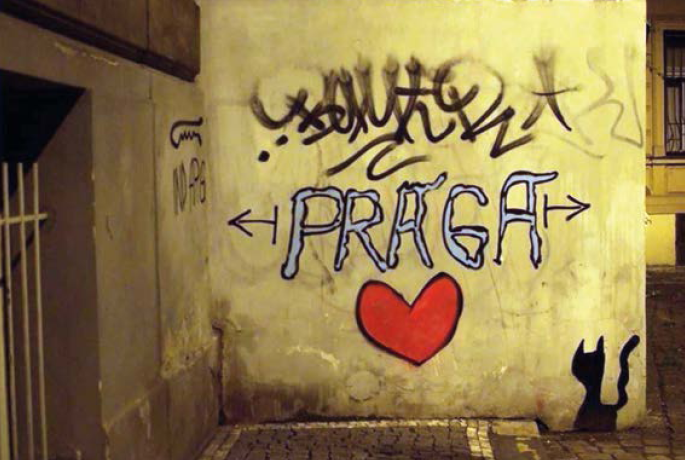 Lucien Lecarme, Untitled, Prague, 2012

